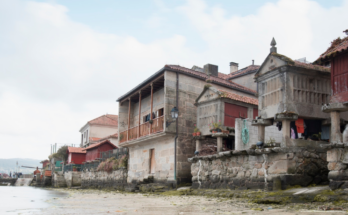

The Arnoia River is 100% Ourense: it is born and dies in the province, with a life of 84.5 km, the longest course of Ourense. It rises in Rebordechau, in the municipality of Vilar de Barrio, in the Serra de Mamede, at 1,300 m, where it joins the waters of several streams. At the beginning of its journey, it is worth climbing to one of the viewpoints of the mountain range, from where you can see everything that once was the Lagoa de Antela. About 20 km from Rebordechau, the Bidueiral of Montederramo, another landscape in which to immerse yourself.
From the headwaters, the river flows in a wide bed, extending to, after Allariz, go more embedded, in the Cartelle canyon, to open again in A Arnoia, where it flows into the river.
The river descends from the heights between meadows and orchards, sheltered by the rich river vegetation. Key points along its course are: Baños de Molgas, Allariz, Cartelle, Cortegada and A Arnoia.
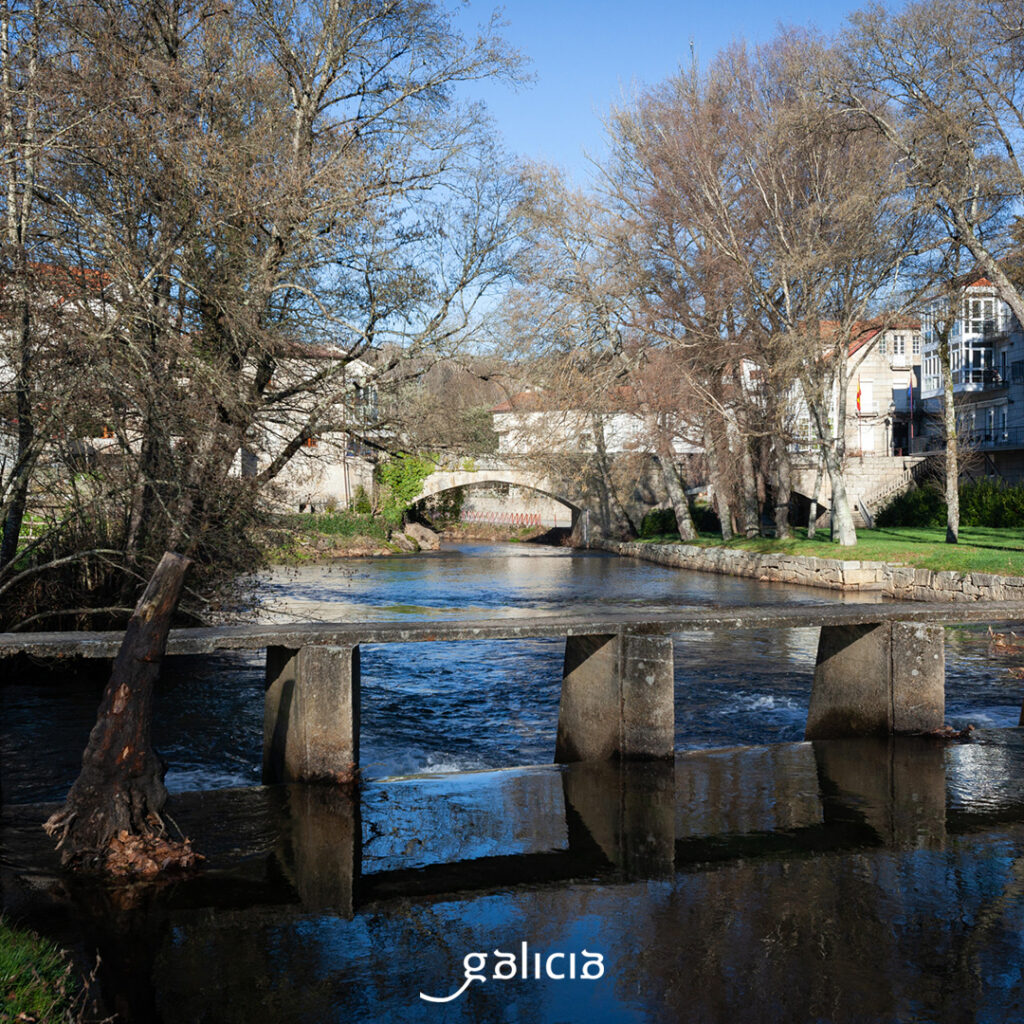
It enters Baños de Molgas from the southeast, from where it goes up and down to the southwest towards A Arnoia. With that name it is easy to deduce what we will find here: water for bathing. This is not just any village: it is a thermal village. Here emanate bicarbonated, sodium-chloride and slightly radioactive waters, very good for dematosis, arthrosis, rheumatism, gout, neuralgia and circulation. In addition to the spa on the banks of the river, another symbol of the village is the medieval bridge, built on the remains of a Roman one.
Baños de Molgas is also known for the pilgrimage to the sanctuary of Los Milagros in Monte Medo. In the same municipality is the ethnographic site of Suatorre, the pre-Romanesque church of Vilariño de Lama Má, the chapel of Santa Eufemia de Ambía and the Baroque chapel of San Vitorio, where there is a petroglyph with a cross on top.
There are several recreational areas on the banks of the river, with space for bathing: A Ansuíña, A Acea and Vide. Between Baños and the village of A Acea, goes the route of O Canón do Arnoia.
Running through mountainous areas, the river extends in a wide valley on its arrival in Allariz, already in its middle course. In this medieval town, protected by the mountains, the river, which crosses the municipality from east to west, has been key to its development. Everything that the Arnoia means to Allariz is well understood when visiting the Ethnographic Park of the Arnoia River, which includes the Moíño do Burato, the O Fiadeiro Weaving Museum and the Leather Museum.
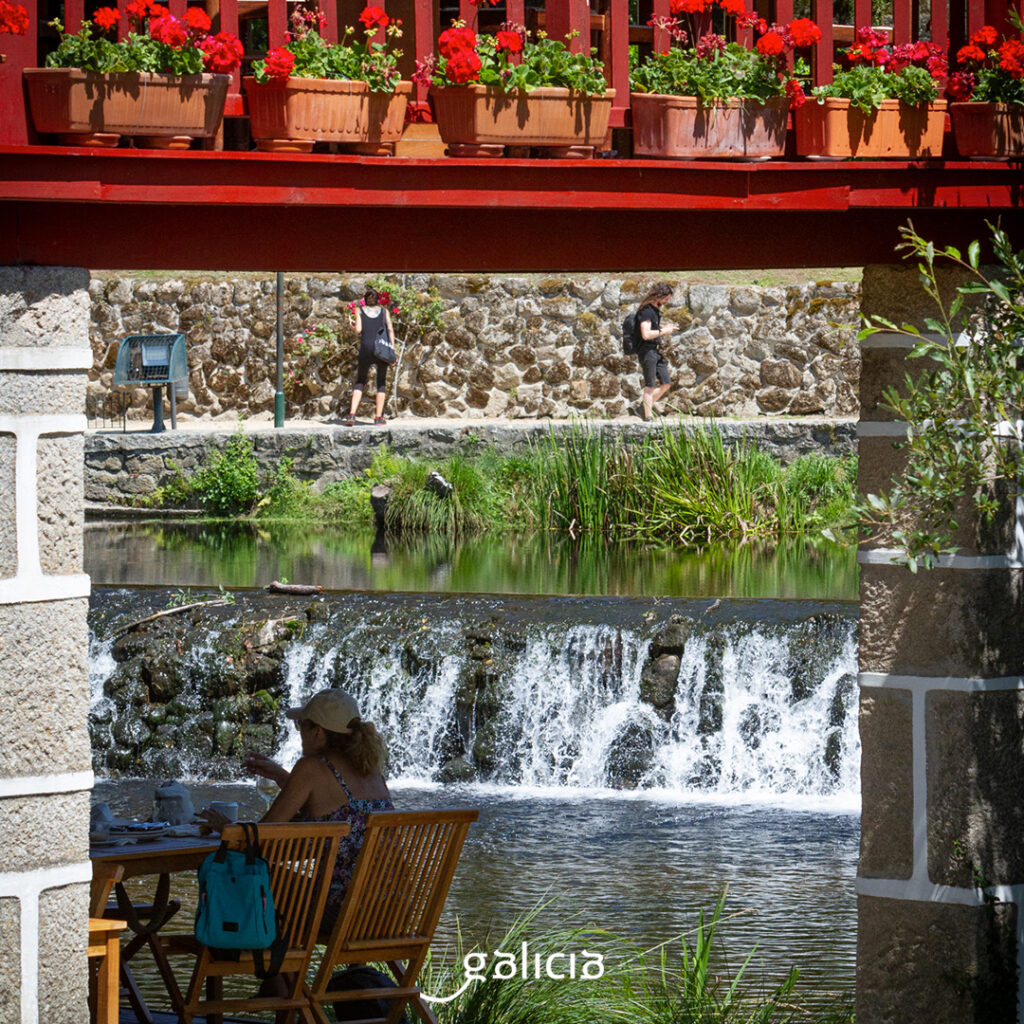
The well-kept historic center, crowned by the remains of the castle of Alfonso IV, reveals the important past of the city, residence of kings and nobles. It is remarkable the convent of Santa Clara, with a very complete Sacred Museum.
Other places full of history and legend are Santa Mariña de Augas Santas; the archaeological-historical site of Armeá, with cibdá, oven (perhaps that of Santa Mariña) and unfinished basilica, and the late medieval site of San Salvador dos Penedos, with the castle of San Salvador de Todea.
Focusing on the river, the thematic corridor of the Arnoia, about 5 km perfectly conditioned, goes from O Rexo, the eco-space intervened by the Ibarrola, to the Festival de Xardíns.
We say goodbye to Allariz with some typical almond biscuits and a coffee liqueur in the backpack and continue the journey of the Arnoia, entering Terra de Celanova, an area historically linked to the Benedictine monastery. Precisely, in Cartelle we can still see the Torre de Sande, remains of the monastery’s fortress, standing out among the rocks. Among the architectural works, we see that the baroque has left its mark, with the churches of Cartelle, As Marabillas in Espiñoso or Mundil, for example.
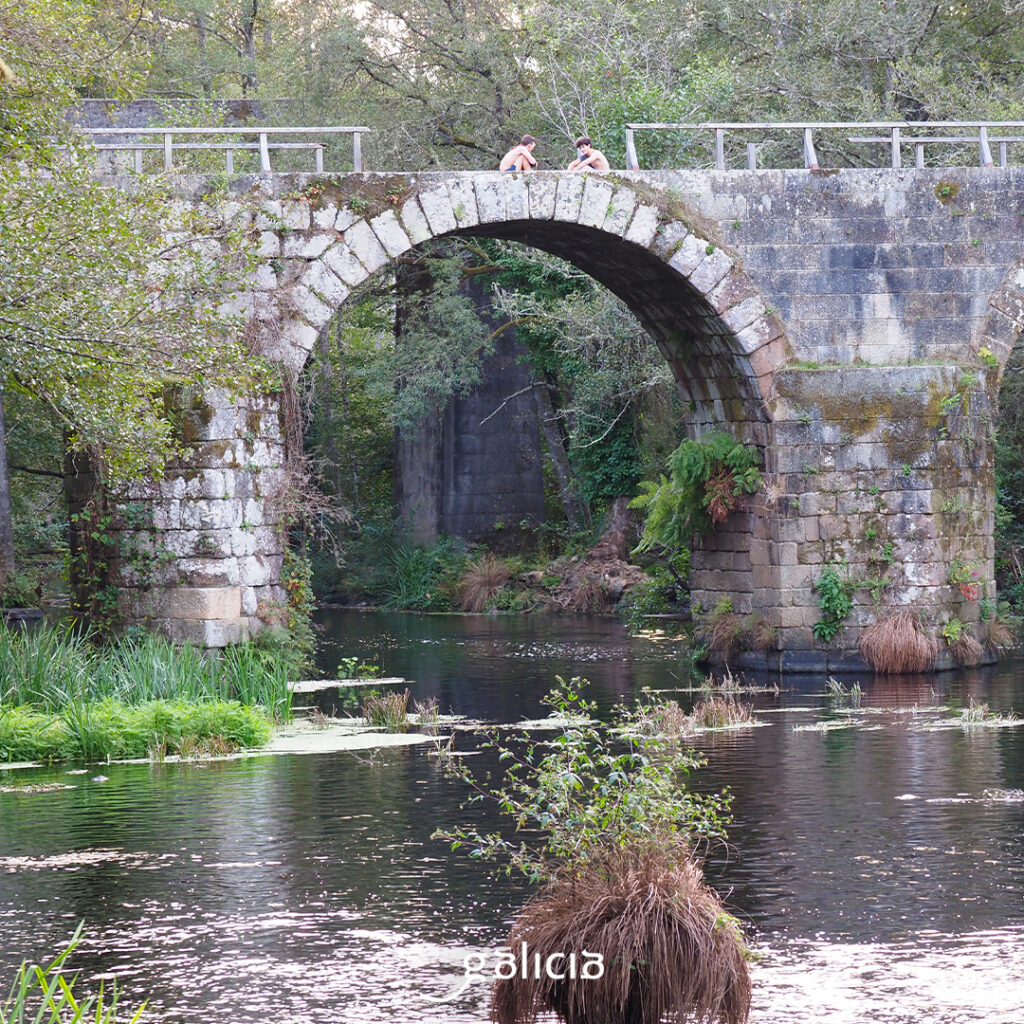
It is worth mentioning Ponte Freixo, a Roman bridge between Freixo and Penela, where the Roman road XVII passed, in the section that went from Aquis Querquennis to Lucus Augusti.
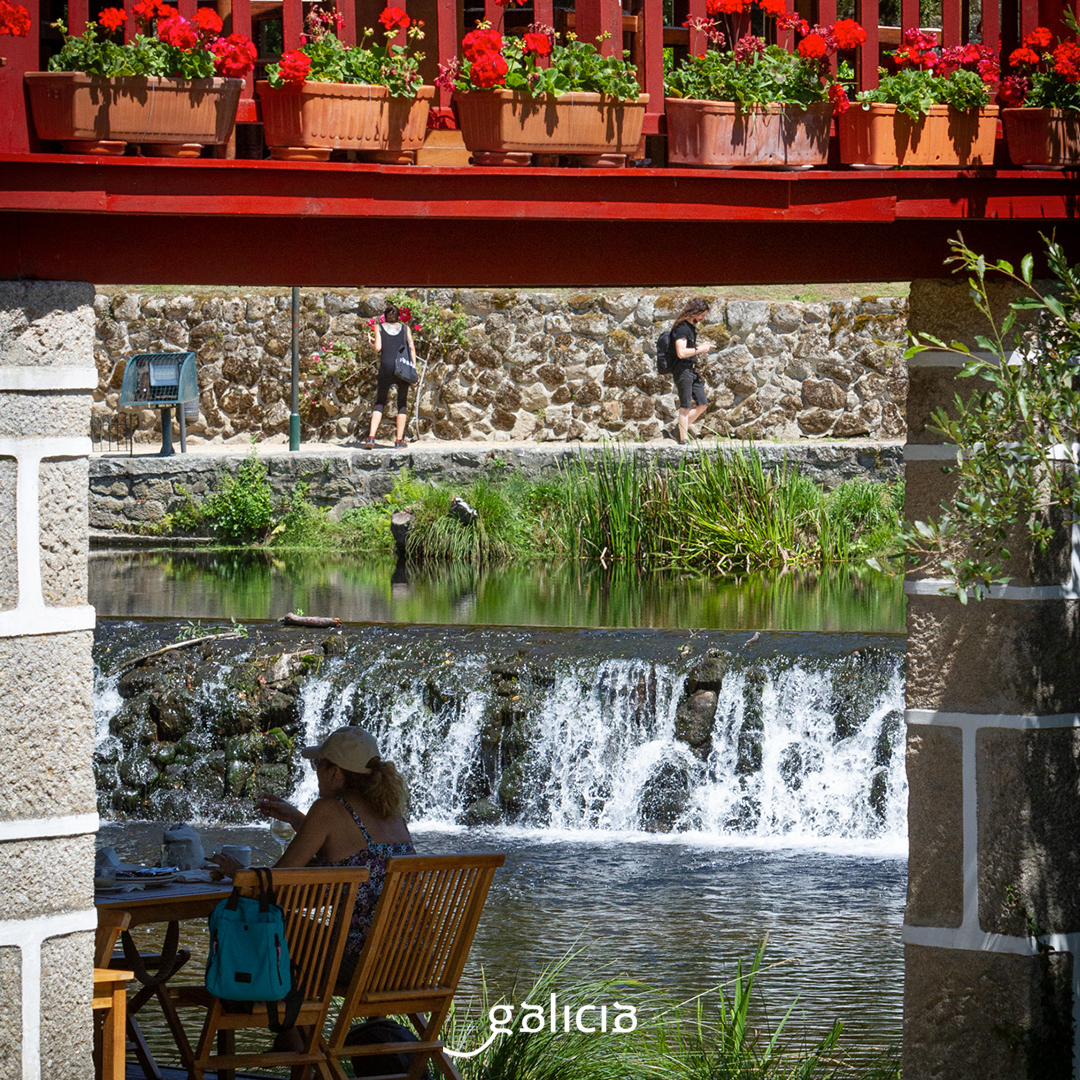
A good area to enjoy the river is the recreational area of Ponte Nova and the Ruta do Santo, which runs along the left bank to the chapel of San Bartomeu, about 4 km of pure nature and intervened by the artist Pepe Alvarez. So, in addition to centenary oak trees, we may also find a tiger. The area is populated with native trees (Carballos, alders, birches …), and has bridges, mills, recreational area and swimming area with a small pier. On August 24 there is a procession to the chapel and a pilgrimage.
In the area of influence of the monasteries there are always vineyards, which implies that there is a lot of wine here, especially when we enter the region of O Ribeiro following the river. At 20 km from Cartelle there is another municipality famous for its baths: Cortegada. It is a municipality more than watered, because the Miño, the Deva and the Arnoia, which here forms a canyon of 200 m of unevenness, flow through it.
The waters have been coming to Cortegada for centuries, but the time of greatest splendor, like all spas in general, was in the nineteenth century, with the construction of a modernist building for the spa. But, since the Frieira reservoir was put into operation, the activity in this center was paralyzed, because of the rise of the waters. So the baths were moved to a higher altitude, near the viewpoint of O Coto da Pena.
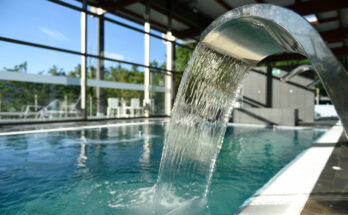
Today, the thermal village has a Thermal Club, with three thermoludic pools, the spa, and the Fonte da Pezoña. The waters of the area are hyperthermal chloride-sodium sulfur waters, good for everything in general and for respiratory and rheumatic conditions in particular.
Cortegada has monuments of interest such as the pazo of the Cid, the Count of Meréns or the sanctuary of San Bieito de Rabiño, from the XVII century, with its curious shrine.
Almost without realizing it, we are arriving at the mouth of our river, in A Arnoia. This river divides the municipality in two from the southeast to the northwest, making its way between mountains and valleys, in a land of wines and peppers. On the other hand, in A Arnoia, the thermal waters do not end suddenly, in fact, on the banks of the Miño there is a large spa-hotel, from which in addition to taking the waters, we can navigate the rivers.
The Arnoia canyon is loaded with vegetation, as we see in the cork oak groves of A Peneda, the mysterious Silvaescura and Inquiau, where we have a recreational area and mills. The medieval bridge and the area of As Poldras follow, where we can fish and have a swim, and where a river walk starts and reaches the mouth, where the Os Castelos islets are located.