
In Pontevedra, the River LĂ©rez is part of the city’s history, and its bridges allow us to travel through it from its origins to contemporary architecture.
From the historic Ponte do Burgo to the striking forms of As Correntes, passing through A Barca and Os Tirantes, each bridge tells part of Pontevedra’s story. And the best thing is that we can discover them on a walk along the river, between the old town, green spaces and some of the city’s most pleasant riverside landscapes.
O Burgo: where the story begins
If we want to start this journey, the best place is Ponte do Burgo.
The history of Pontevedra is closely linked to this spot. An ancient Roman bridge, known as Ponte Veteri, lies behind the city’s name, although no remains of that original bridge survive. Archaeological excavations in the surrounding area have, however, uncovered Roman remains and parts of the medieval bridge, which was built in the 12th century.
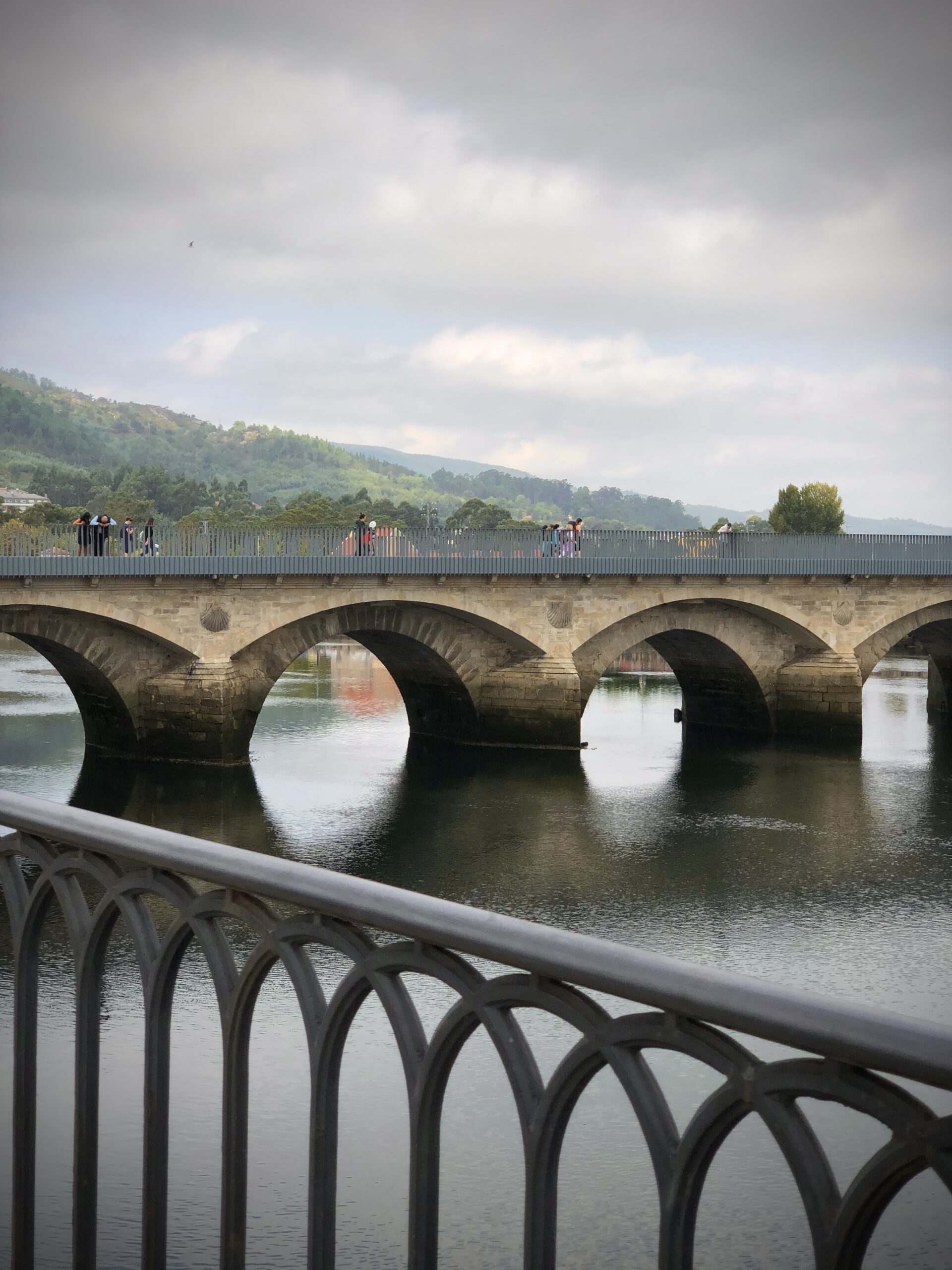
The bridge we see today is the result of numerous alterations carried out over the centuries. Its eleven visible arches, stone construction and location beside the old town make it one of Pontevedra’s most recognisable landmarks.
It is also part of the Portuguese Way to Santiago. The scallop shells on the bridge are a reminder of the pilgrims who have crossed the LĂ©rez for centuries on their journey to Compostela.
This is also a good place to explore the archaeological surroundings of O Burgo, where remains of the old city walls, a 15th-century quay and other features help us understand the importance this area once had in the history of the city.
A Barca: a bridge with a maritime past
Following the river towards the estuary, we come to Ponte da Barca, whose name recalls the boats that for centuries allowed people to cross the river at this point.
In the 19th century, a wooden bridge was built here, with a lifting section to allow boats to reach the quays near O Burgo. The structure was later replaced by a new bridge, completed in 1905, whose central metal section remains part of the bridge we see today.
Its history reminds us that bridges were not only built to connect two banks. They were also closely linked to the port, trade and Pontevedra’s relationship with the sea.
From here, we can also enjoy one of the city’s most characteristic riverside views, with the river opening out towards the estuary.
Os Tirantes: when Pontevedra looks to the future
Leaving the historic bridges behind, we continue our walk beside the LĂ©rez until we reach a completely different structure.
Ponte dos Tirantes was inaugurated in 1995 and marked a new chapter in Pontevedra’s urban landscape. Designed by Leonardo Fernández Troyano and Javier Manterola, it features a 63-metre-high concrete tower from which 17 pairs of cables support the bridge deck.
Its striking presence beside the river and the Pazo da Cultura and exhibition centre makes it one of the city’s most recognisable examples of contemporary architecture.
But the visit does not end when we cross it. The surrounding area allows us to continue along paths following the LĂ©rez and reach Illa das Esculturas, a space where nature, art and landscape come together beside the river.
It is a fine example of how Pontevedra has turned its riverside areas into places to walk, explore and enjoy the city.
As Correntes: a bridge for walking, cycling and taking in the view
The final major bridge on this route is also the newest. Ponte das Correntes opened in 2012 and stands out for its two large metal arches and its design, which accommodates different forms of mobility.
It has four lanes for vehicles, a cycle lane and covered pedestrian areas, connecting the two banks of the LĂ©rez. Its arch structure also creates a visual dialogue with the forms of A Barca and O Burgo.
But perhaps the most appealing thing for visitors is that this bridge is not simply a way of getting to the other side. Its pedestrian routes bring you closer to the river and offer a different perspective over the water.
And if you take the walk as evening falls, the bridges become the protagonists of another Pontevedra. The lighting of O Burgo and As Correntes creates reflections on the LĂ©rez and gives the route an entirely different atmosphere.
A walk among bridges, river and city
One of the best ways to discover Pontevedra is to follow the LĂ©rez and let its bridges guide the way.
We can start at O Burgo, head towards the old town, continue to A Barca and then make our way to Os Tirantes and As Correntes. Between the bridges we find squares, cobbled streets, green spaces, historic buildings and places to sit beside the river.
We can also take a detour into the old town and explore some of the places associated with the Portuguese Way. From Praza da Peregrina, the route crosses the heart of the city before reaching the river and O Burgo, combining heritage, pilgrimage and urban landscape.
In this way, the bridges become more than simple crossing points: they become a different way of discovering Pontevedra.
Pontevedra, a city between two banks
More than three hundred bridges cross rivers and streams throughout the municipality of Pontevedra, but those spanning the LĂ©rez as it passes through the city offer a particularly fascinating journey through its history.
O Burgo tells us about the city’s origins and the Way of St James. A Barca recalls its relationship with the port and the sea. Os Tirantes represents the arrival of a new architectural language, while As Correntes reflects a city that continues to transform its riverside spaces.
Four bridges, four moments and one river.
Because crossing Pontevedra is also about discovering how a city has grown around the water, preserved its memory and turned its riverbanks into places to walk, meet and enjoy.
Fancy crossing it?