
There are places where the most fantastic is mixed in a natural way with the most earthly. In Galicia these places abound, so we have a thousand legends to tell. Let’s start with a few:
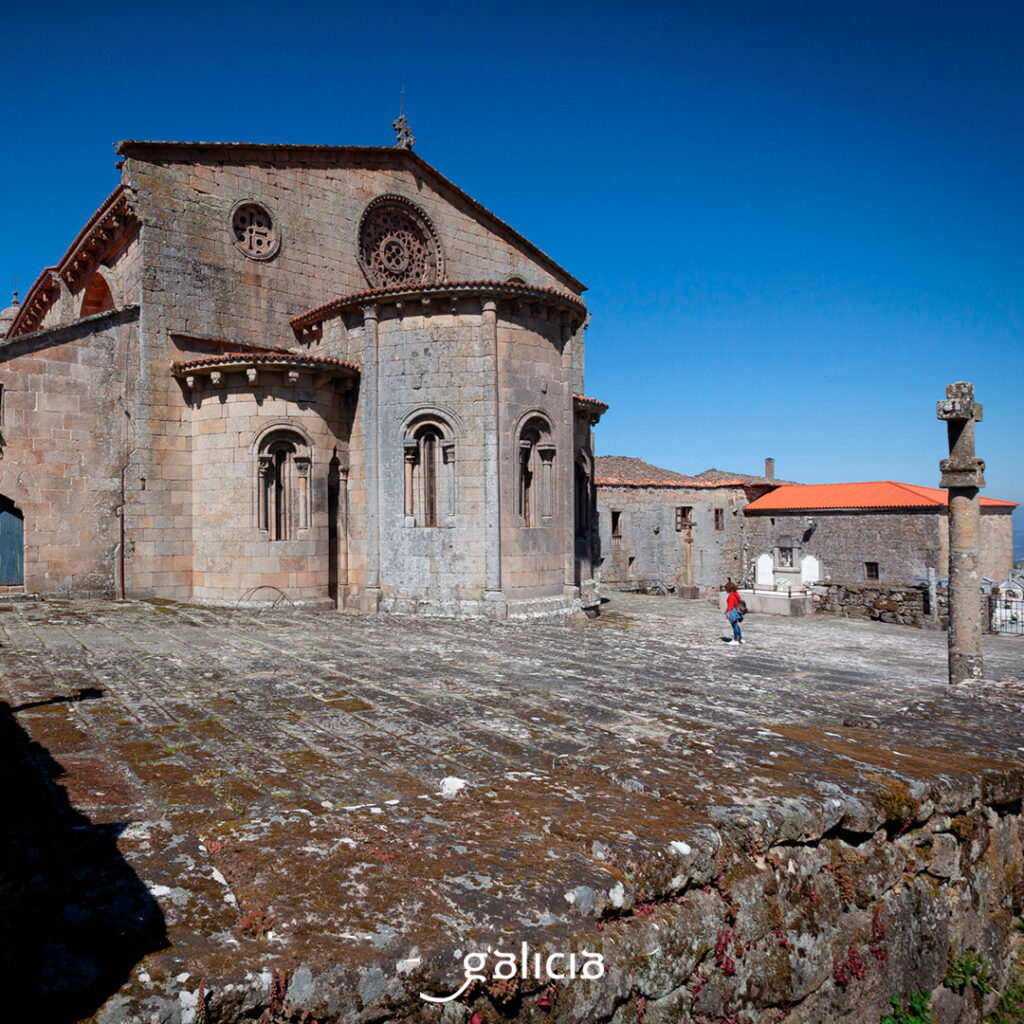
Santa Mariña de Augas Santas. In this small parish of Allariz, in the province of Ourense, we find archaeological remains of different origins magically united by the legend of Santa Mariña. The story begins in the 2nd century, with the harassment suffered by Mariña, a young shepherdess, by Olibrio, prefect of Armeá, a Galician-Roman town. Faced with Mariña’s refusal to leave with him and renounce Christianity, the prefect decided to martyr her. The fact is that he was unable to do so, for, after each mortal torture, the girl managed to escape after three days. Then, Olibrio sentenced her to burn to death in a furnace. But the girl freed herself again, this time with the help of Saint Peter, who took her out of the furnace and cooled her in a pond. Fed up with Mariña’s insolence, who would not die, Olibrio beheaded her on 18 July 139. When the body was separated from the head, it fell three times on the ground and, miraculously, a fountain sprang up in each place of the fall. She was buried there and a church was built. The church we see today is later, Romanesque, and contains the tomb of the saint. Nearby, in the chapel of San Tomé, is the Well of the Saint (one of the legendary fountains) and the Fountain of the Saint (another of the fountains), with three spouts of miraculous water.
Nearby, in the crypt of the unfinished 13th century Basilica of the Ascension, we discover what is said to be the oven in which she was martyred. To round off the legend, in the same area was the enormous Carballo da santa, an oak of which Vicente Risco said that blood would flow from it if someone were to cut it down. Too bad it died on a stormy night…
To immerse yourself in the legend, the ideal way is to follow the archaeological route between Armeá and Augas Santas, about 2 km long.
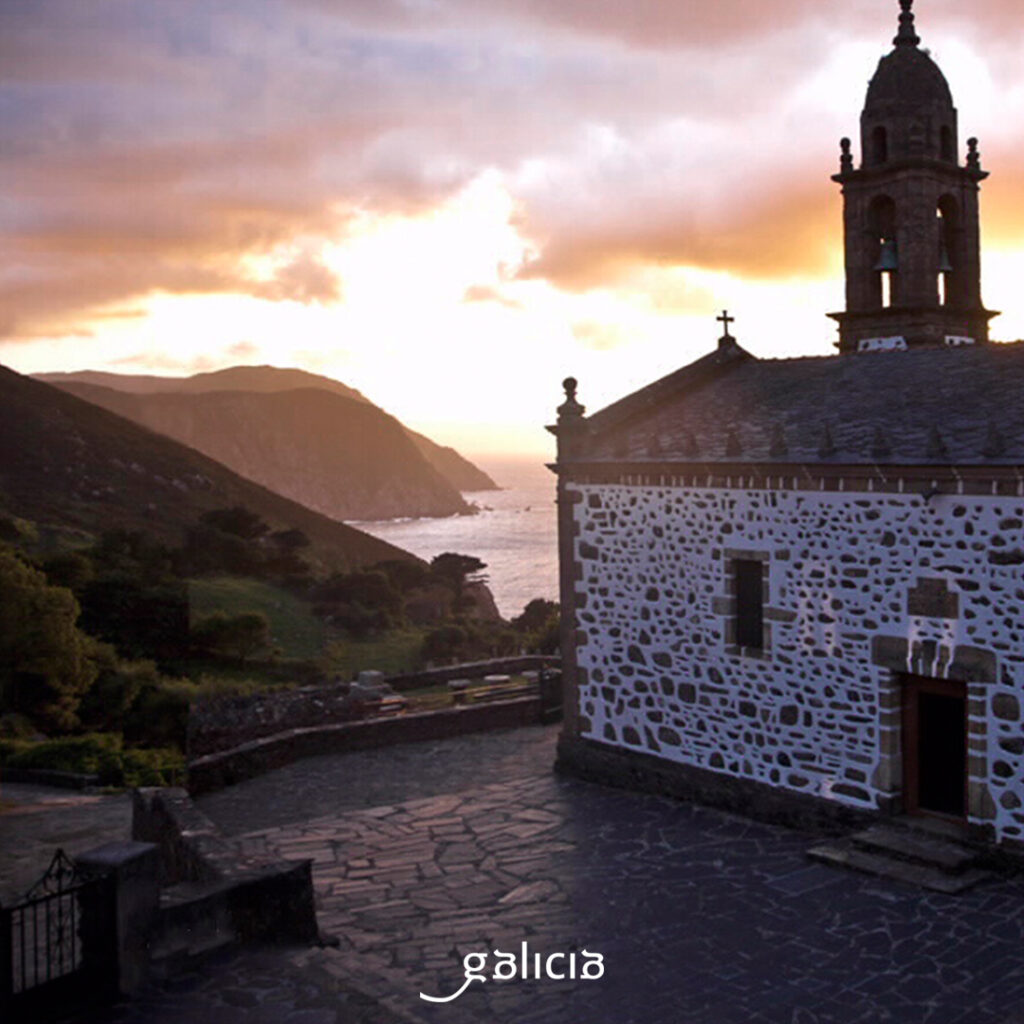
Santo André de Teixido. There is a place of pilgrimage in Galicia almost as famous as the cathedral of Santiago. It is in the municipality of Cedeira, on a vertiginous slope of the Serra da Capelada, in a landscape that encourages the imagination.
The oldest legend has to do with the Alén gates of Celtic tradition, which used to be found in places with magnificent views of sky and sea. On the other hand, the yew tree, abundant in the area, has always been considered a sacred tree, symbol of death and eternal life at the same time (tejo, teixo, Teixido).
Christianity took care of the other legends. One says that, after Saint Andrew was shipwrecked on this coast (the boat would become the largest of the Gabeiras Islands), God ordered him to found a sanctuary and, as compensation for staying in such an isolated place (Santo André de Teixido was formerly known as Santo André de Lonxe), he would make it a pilgrimage destination. The saint would not have a cathedral, but his sanctuary would be visited by all believers and, if not in life, up to three times after death, either in the form of an animal or in spirit, accompanied by their relatives. Hence the saying ‘A Santo André de Teixido, vai de morto quen non foi de vivo’.
Another legend tells that Jesus and Peter were here looking for the places where God had rested his hand after creation, giving shape to the Galician estuaries. They became hungry and God sent them an apple, but not just any apple, because inside it was Saint Andrew, who freed himself once they had eaten it. He was commissioned to found a sanctuary there. He did not want to stay in such an isolated place, but Jesus promised him that he would receive many visitors.
And visitors do come. Santo André became a real pilgrimage centre, with the sanctuary (the one you see today is from between the 16th and 18th centuries); the fountain of the three spouts (where you have to make a wish, throw a crumb of bread and if it floats it is granted); the cave of offerings (an artificial cave to leave candles and votive offerings) and several milladoiros de camino (where each pilgrim deposits a stone from where he or she comes from, so that the saint knows who has to come from when he or she dies).
Let’s not forget the herba de namorar and the xunco do ben parir, for good luck in love and births, and the sanandresiños, amulets made of baked breadcrumbs and painted in bright colours.
Tradition dictates that the pilgrims return with a bunch of hazel and yew sticks. And also with doughnuts from Santo André for the way…
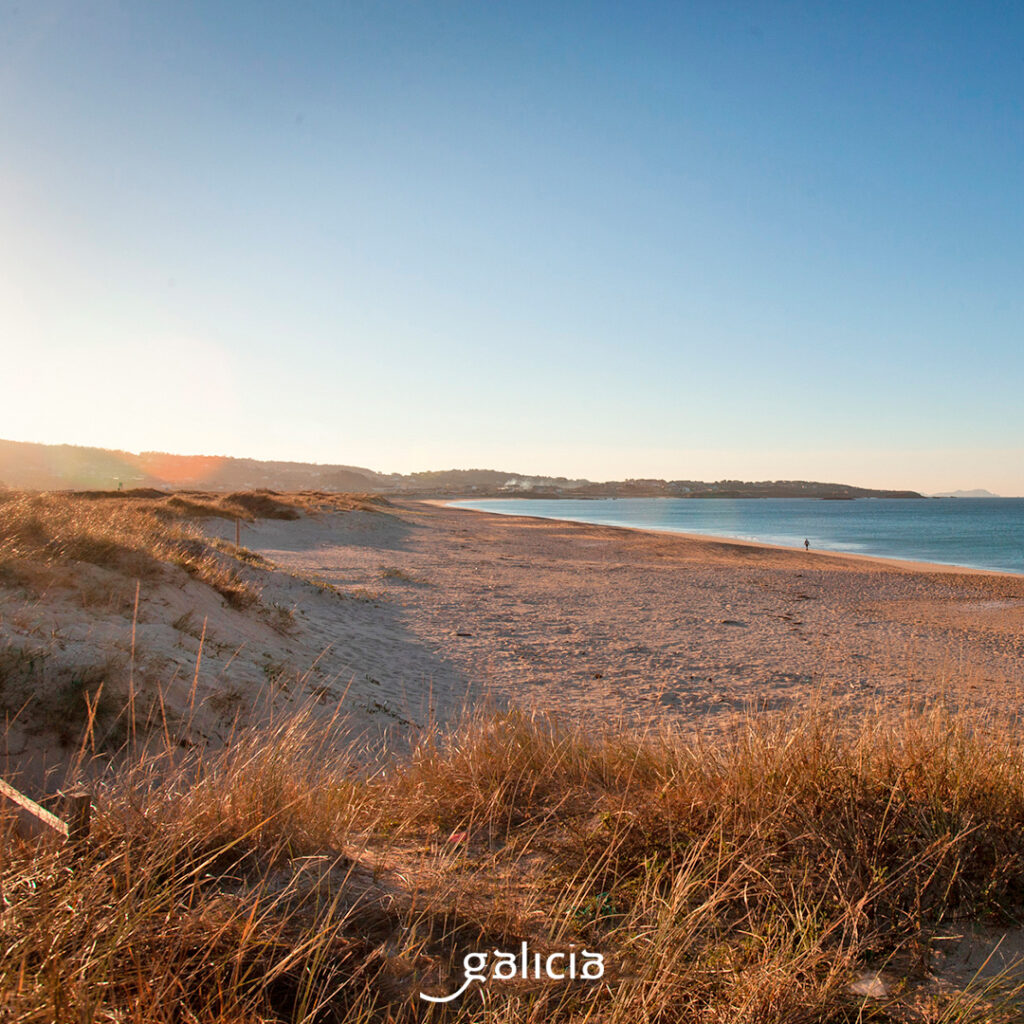
The nine waves of A Lanzada. In the municipality of Sanxenxo, between Punta de Noalla and Punta de Portomouro, the point of the chapel of A Lanzada juts out into the sea. On this small promontory, within a few metres, we have the Tower of A Lanzada, the remains of a medieval fortification; a Romanesque chapel, erected on top of an older one, and the remains of a hillfort and a Bas-Roman necropolis.
The last weekend in August is the pilgrimage of the Virgin of A Lanzada. On Saturday night, it is traditional for women who want to become pregnant to take the ‘bath of the nine waves’ on the beach of Nosa Señora, next to the hermitage. At dawn, they must sweep the floor of the hermitage, to cast out the evil eye, and make an offering to the Virgin. The bath is also taken in San Juan night. Another variant is to take it at dawn under the full moon and then lie down on the rock known as ‘the bed of the Virgin’.
As if that were not enough, A Lanzada is also the starting point of the Santa Compaña to the Illa de Ons, or in other words, to the afterlife. During the month of the dead, the Santa Compaña route is organised.
Stones of A Virxe da Barca. In the municipality of Muxía, where the Fisterra and Muxía Way ends, we find the sanctuary of A Virxe da Barca, a church that has been rebuilt several times over the centuries. In 2013 it suffered a fire and was refurbished again.
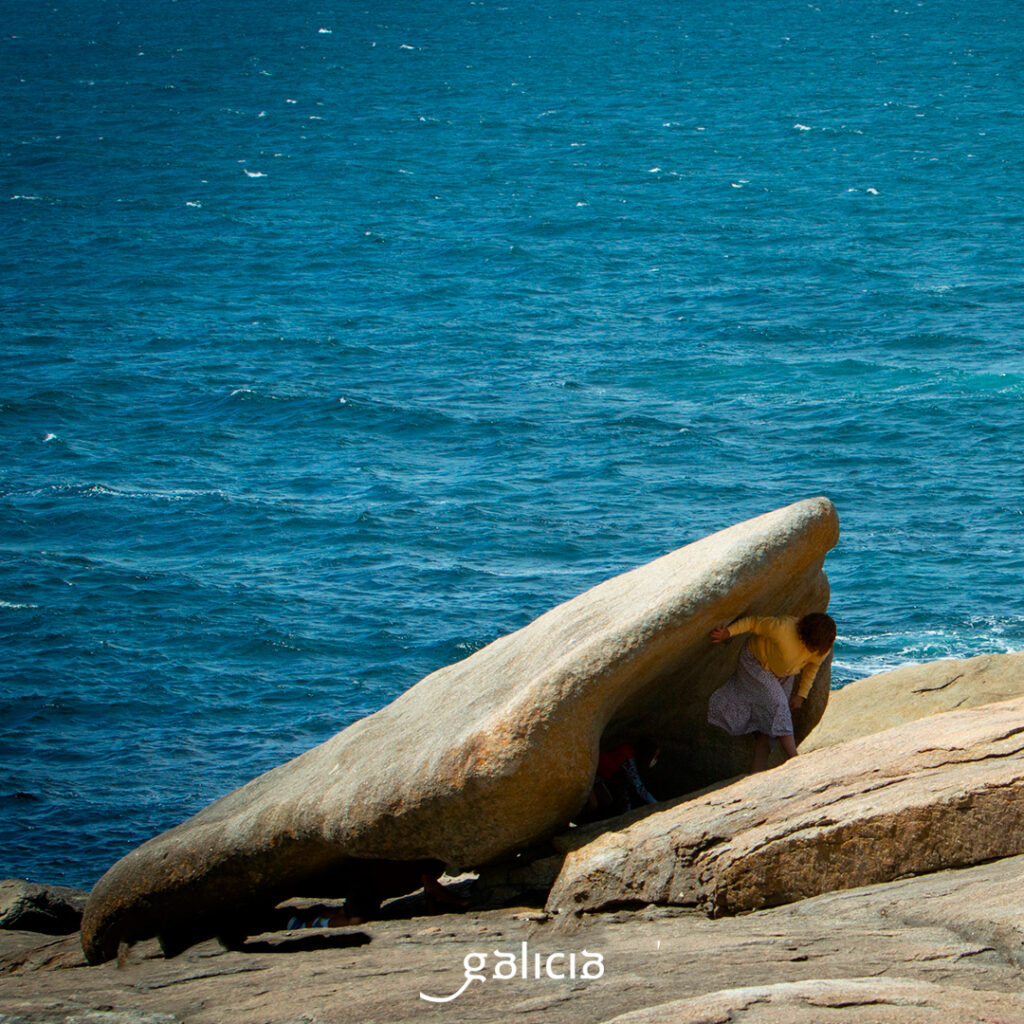
The story goes that the Virgin arrived in this corner of the world in a stone boat to support the Apostle Santiago. The remains of the boat would be the large rocks surrounding the temple: Pedra de Abalar (the sail), which had to be climbed on and swung over; Pedra dos Cadrís (the hull), which had to be passed under nine times to cure kidney ailments and rheumatism, and Pedra do Temón (the rudder). In addition to these, tradition added the Pedra dos Namorados.
There is also talk of the Sala do Perello, a hollow between the rocks where a tailor was said to live, and the Fonte da Pel, where the pilgrims, many of them sick, who followed the Camiño da Pel, the old route to the sanctuary, washed themselves.
The second Sunday in September is the pilgrimage of A Virxe da Barca, and there is a procession to the port of Muxía.
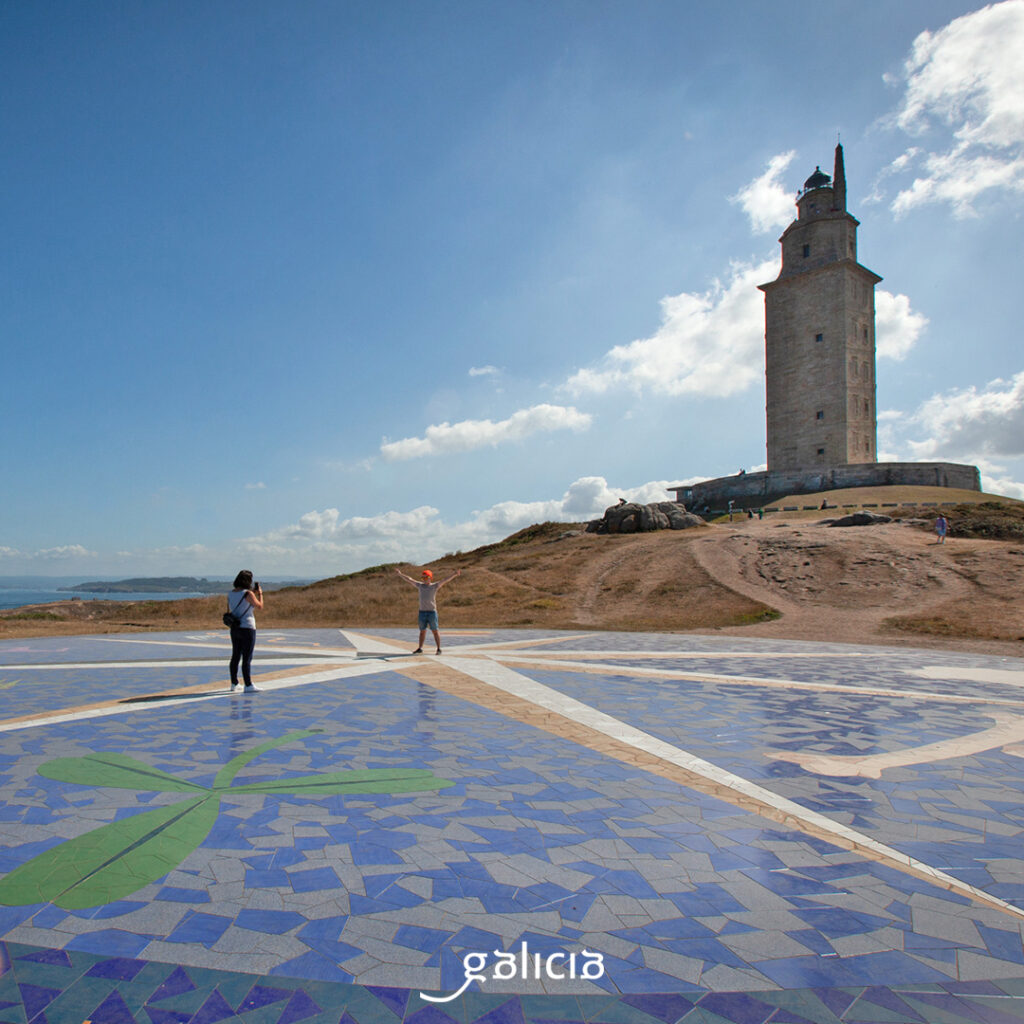
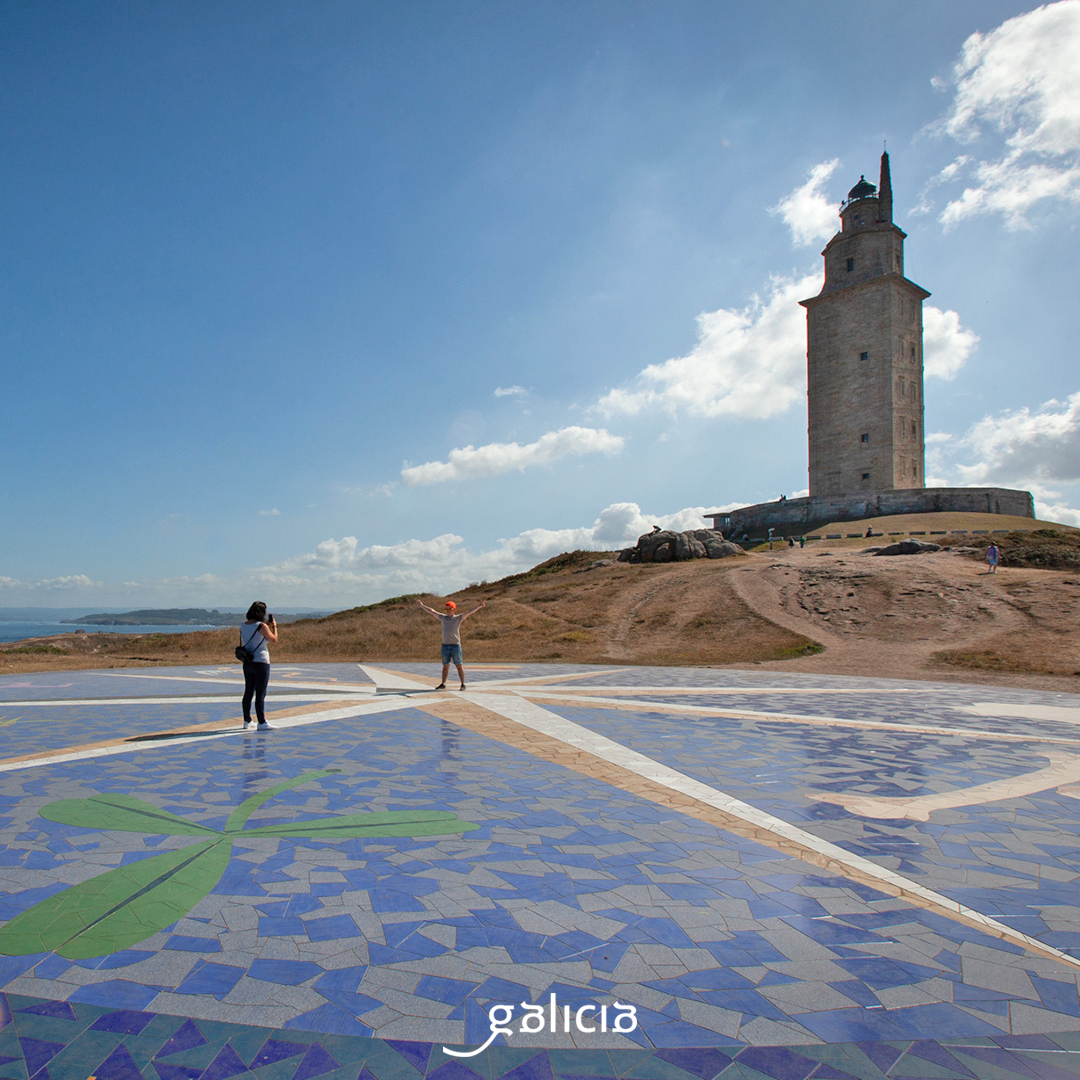
The Tower of Hercules. It makes you dizzy to think that this very lighthouse, or at least its foundations, has been standing and guiding ships since the 2nd century, one of the reasons why it was named a World Heritage Site in 2009. According to the inscription at its base, the tower was erected by Gaio Servio Lupo, architect of Aeminium (today’s Coimbra). But its mythological origin is another story…
Alfonso X tells us that Hercules killed the giant Geryon here, that he buried his head and that he built a tower on top of it (as we can see in the coat of arms of A Coruña) and, around it, a city. The first person to inhabit it, a woman called Crunna, would be the one to give it its name (A Cruña). When Hercules left, his nephew installed a lamp that never went out and mad
e a very large mirror through which enemy ships could be seen.Another legend, collected in Lebor Gabála Érenn, book about ancient Irish legends, tells us that it was Breogan, the mythological Galician king, founder of Brigantia (A Coruña), who erected the tower. From the top, his son Ith sighted the land and tried to conquer it, but died in the attempt. It would be his son, Mil, who would end up avenging his father and founding Ireland.