
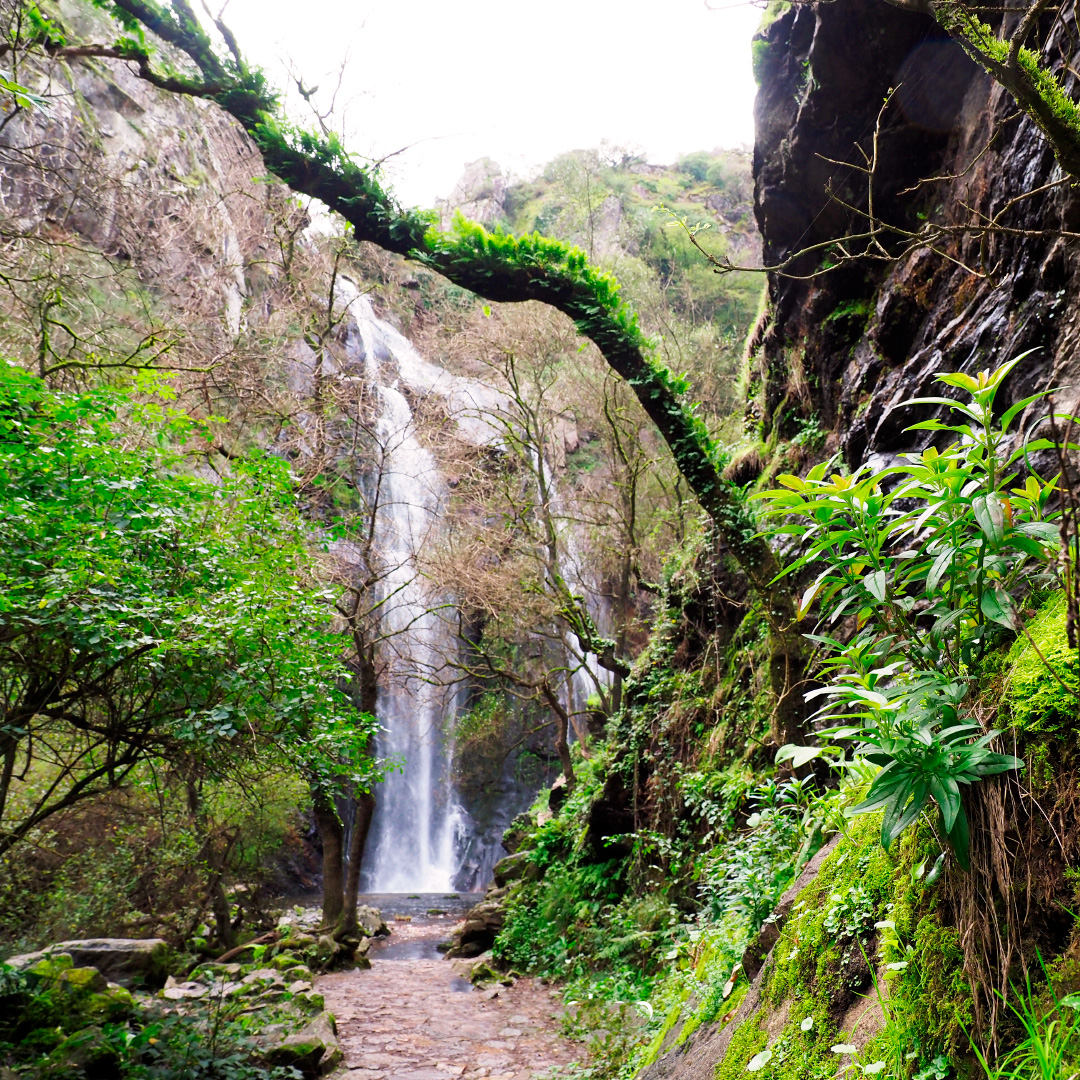
The cataloging of fervenzas (waterfalls) of Galicia is a hard work, given the amount of water that flows through this land. Calculating on the low side, we could be talking about more than 300 waterfalls… Turismo de Galicia has made a practical list of 76 fervenzas, classified according to their most obvious characteristics (if they carry a lot of water, if they run between large stones, if they are narrow, if they are high…) We show below these categories with some representative examples of each one. The entire catalog can be found here: https://www.turismo.gal/que-visitar/espazos-naturais/fervenzas-de-galicia
For example, among the highest and most elegant fervenzas, the Seimeira de Vilagocende, in A Fonsagrada (Lugo), or the one of As Hortas or Santa Marta, between Arzúa and Touro (A Coruña), where the legend says that a girl was thrown by her boyfriend down the waterfall and, when she shouted “Santa Marta me vaia!” the branch of an oak tree stopped her fall and saved her life. Although, if we talk about the highest fervenza in free fall, there we have the O Toxa, in Silleda (Pontevedra), with a jump of more than 70 m.
If we look at the flow, there is plenty of water in O Ézaro, in Dumbría (A Coruña), which is thrown into the sea from a height of about 30 m, a unique case of a waterfall; in Barosa, in Barro (Pontevedra), next to the path of the Barosa mills, with a drop of 30 m and several jumps; or in Tourón, in Melón (Ourense), among others.
Vertical waterfalls can be found in O Pozo do Inferno, in Ortigueira (A Coruña), which is always abundant and has a wooden bridge; in O Salto do Coro, a tributary of the Valiñadares, in Mondoñedo (Lugo), which forms a good pool when it joins the Masma, or in the famous fervenza de Auga Caída in the Ribeira Sacra, in Pantón (Lugo).
There are also fervenzas with what is called ponytails, which spread their waters widely over the rocks, like a thick mane. Among these, the Augas Caídas de Mañón (A Coruña), in which the waterfall, also called A Mexadoira, falls from the river Seixo to the Sor with a height of 50 m; or the Brañas, in Toques (A Coruña), almost 40 m high.
There is a very peculiar fervenza, in which two waterfalls cross forming an “x”, which has been catalogued as “the most Galician”. It is O Muíño da Serra or Pereiro in the river Pereiro, a tributary of the Ulla, in Boqueixón (A Coruña).
If we look for fervenzas in the woods we are sure to find one, such as A Rexidoira, in Oza-Cesuras (A Coruña); Gosalfre, in Mazaricos (A Coruña); or A Ruxidoira, 8 m high, in Paradela (Lugo), in an area of waterfalls and mills.
There are also fervenzas between corgas, on narrow slopes, such as the Corga da Fecha, near the Balneario de Lobios (Ourense) which, although it is one of the highest in Galicia, is only visible on days of heavy rain. Another of this style is the Entrecruces, in the municipality of Carballo (A Coruña), which plunges into the Outón river from a height of about 40 m, or the Hérvedo, for example, near the Castro Castrolandín in Cuntis (Pontevedra).
Other fervenzas do not stand out for the height of the fall or the flow, but for the rhythm with which they descend, for their movement. We can say that they carry dancing waters. Among them, the one of O Rexedoiro, in Val do Dubra (A Coruña), for example, which falls in two sections that together reach a height of 10 m, or the one of A Pena dos Portelos, in Ribeira de Piquín (Lugo).
For daring people, there are fervenzas that are a challenge, such as Fondo da Petada, in Quiroga (Lugo), with a very narrow and slippery access; Pombar, also in Quiroga, or A Poza da Seima or Pozo Negro, in Lobios (Ourense).
There are small but handy waterfalls, such as Castriz in Santa Comba (A Coruña), with a large recreational area in the river Mira, or Caldeiras do Castro, in Muxía (A Coruña), surrounded by small natural pools. Here the fall is 8 m and is the border between the municipalities of Muxía and Dumbría.
If we are looking for pools to have a good swim, we have up to eight cataloged. Among them, Pozo da Ferida, in the river Xudreiro, a tributary of the Landro, in Viveiro (Lugo) or Pozo da Onza in Budián, in O Valadouro (Lugo), which falls more than 20 m high, or the Seimeiras de Queixoiro, in A Fonsagrada (Lugo).
Other waterfalls run between large rocks like slides, such as the Escouridal, in O Pereiro, in Alfoz (Lugo), in the Guilfonso river, where a rope anchored in the rock allows us to approach the foot of the waterfall. It also runs between large rocks A Misarela, in San Xoán river, in A Pobra do Caramiñal (A Coruña), preceded by the pools of the Pedras river. The fervenza de Segade, in Caldas de Reis (Pontevedra), also has natural pools frequented in summer.
We finish with very lively waters, the unruly springs, such as those of the fervenza da Noveira in Mazaricos (A Coruña), in the Arcos river, which is also part of the route of the fervenzas of the municipality; those of Raxoi and Parafita, in Valga (Pontevedra), accompanied by mills and pools, or that of Ribasieira, in the Sieira river, in Porto do Son (A Coruña), where there are jumps of between 20 and 4 meters.