
If there’s something that makes Galicia special in spring, it’s its landscapes full of green, wildflowers, and that fresh air that makes you want to get outside.
Did you know that Galicia has six declared natural parks? These are protected areas where nature has barely been touched by humans and which stand out for their landscapes, wildlife, flora, and even geological curiosities. If you’re looking for outdoor plans this spring, keep reading!
- Fragas do Eume
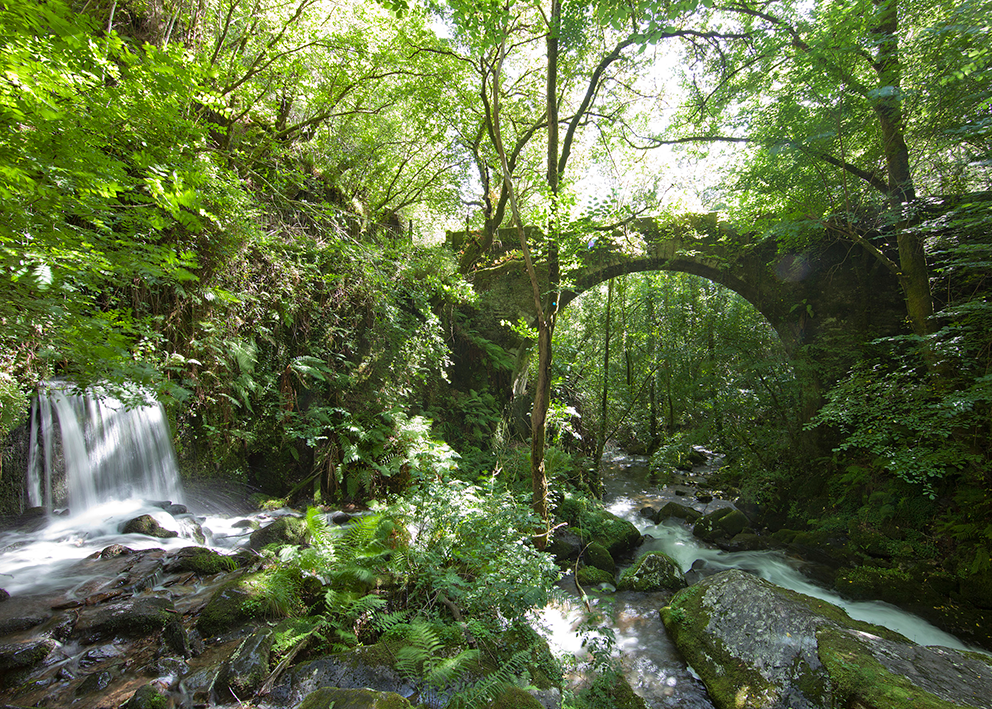
If you love getting lost in impressive forests, this place is a gem. Fragas do Eume, in A Coruña, is one of the best-preserved Atlantic riparian forests in Europe, with more than 9,000 hectares of almost untouched nature following the course of the Eume River.
The best way to explore it is on foot, walking trails where sunlight barely penetrates the thick vegetation. Oaks, alders, ash trees, and more than 20 species of ferns coexist with lichens and moss, creating that intense green atmosphere that only spring brings.
A classic plan is to visit the Monastery of San Xoán de Caaveiro, an ancient monastery with over 10 centuries of history hidden in the heart of the forest. The views from there over the treetops are spectacular.
The park isn’t just about plants: it also hosts a wide variety of wildlife, and if you pay attention, you might spot birds like the dipper or traces of mammals living in the forest.
- Corrubedo and Carregal & Vixán Lagoons
If you’re looking for a different plan by the sea, this coastal park in A Coruña is ideal. Its main star is the huge dune, over a kilometer long, 250 m wide, and reaching 20 m high in front of the ocean—a true “queen of sand” moving with the wind.
The park combines dunes, beaches, and lagoons in a unique landscape. Corrubedo Beach coexists with two main lagoons:
- Vixán, a freshwater lagoon surrounded by reeds, home to many water birds.
- Carregal, a brackish lagoon that connects to the sea, creating a vibrant ecosystem where tides, birds, and marine life mix.
You can explore the dunes via marked trails and boardwalks, enjoying the park without harming its delicate ecosystem. And if you love birdwatching, bring binoculars: Corrubedo hosts thousands of water birds, especially active in spring.
- O Invernadeiro
If you’re looking for an almost wild destination in the heart of nature, the O Invernadeiro Natural Park, in Ourense, is unforgettable. This space, with 6,000 hectares of mountains and valleys, sits in the heart of the Ourense Central Massif, a territory of gentle slopes, rugged rocks, and forests that seem endless.
There are no urban settlements within its limits: only pure nature, free wildlife, and silence. It’s the perfect place to feel truly immersed in the Galician landscape.
In spring, the park comes alive with color and movement: streams and rivers flow strongly, holly, yew, and sorb trees look fresh and green, and birds of prey, like eagles and falcons, soar above the mountains.
You don’t need to be an expert to enjoy it. Access is managed with prior permission, and most trails are on foot, making the experience more authentic. Some routes lead to fascinating places like glacial cirques, waterfalls, or viewpoints, while others take you into the heart of the forest, where you can sense that special silence that only a well-preserved environment can offer.
- Serra da Enciña da Lastra
If you want to discover a corner of Galicia with its own personality, Serra da Enciña da Lastra is worth a visit. This natural park in Ourense lies in the Sil River valleys, and its limestone peaks are a rarity in Galicia, where granite dominates.
Nature here has a special touch: oak and chestnut forests, thyme-scented meadows, and more than 25 orchid species, giving it an almost Mediterranean feel.
One of the park’s hallmarks are the “palas”, caves and rock cavities filled with stalactites and stalagmites, home to bat colonies. The Sil River winds through spectacular gorges, and traditional villages dot the landscape. Some trails, both on foot and by car on rural roads, let you discover viewpoints and hidden corners.
- Baixa Limia‑Serra do Xurés
If you’re looking for an escape where nature, history, and landscapes mix, Baixa Limia‑Serra do Xurés in Ourense is a place that leaves unforgettable impressions. Located in southwest Galicia, nature here doesn’t respect borders: crossing the Xurés mountains takes you into the neighboring Peneda-Gerês National Park in Portugal.
The park offers Atlantic forests, deep valleys, and rugged mountains, with colors and textures that change at every step. The Limia River forms waterfalls, reservoirs, and small cascades ideal for enjoying the surroundings.
History also thrives here: the Roman Vía Nova crosses the territory, and traditional villages retain their charm. In spring, oaks and strawberry trees look green, wildflowers fill the meadows, and you might see eagles, wolves, or Garrano horses roaming freely. Highlights include the A Fecha waterfall and the Corga da Fecha natural pool.
You can explore it on foot, by bike, or on horseback, and several routes by car connect viewpoints, villages, and points of interest. The park also preserves cultural heritage like mills, granaries, and stone enclosures.
- Monte Aloia
If you want a quick getaway into nature without going far, Monte Aloia is perfect. Near Tui (Pontevedra), it was the first natural park declared in Galicia. Though small, it offers a varied and beautiful landscape to explore in spring.
It’s part of the Serra do Galiñeiro and rises as a lookout with spectacular views over the Miño River and its valleys, ideal to feel on top of the Galician landscape.
There are marked trails totaling about 10 km, including footpaths, viewpoints, and recreational areas, perfect for strolling when the hill is full of color with gorse, rockrose, or heather. There are also historic remains, like old mills, adding a special touch. To start, the “Centro de Visitantes” Forest House provides information on trails and local nature.
What are you waiting for to put on your boots and discover them? Each park has its own magic, and spring is the perfect time to feel it.